Does Turkey Tail Help Immunity?
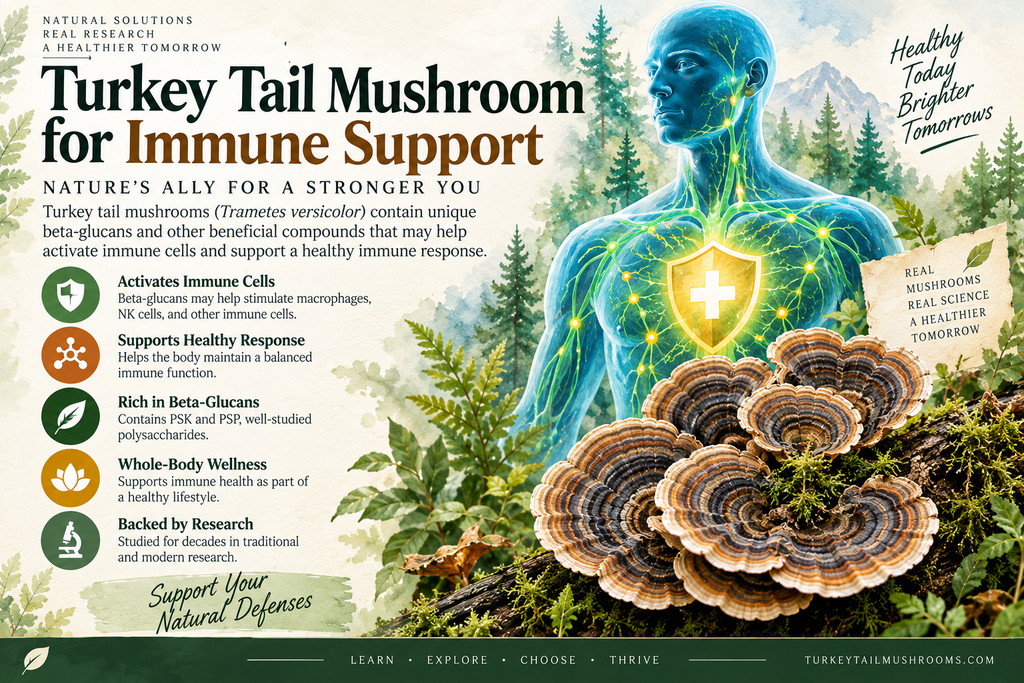
Turkey tail is frequently promoted as an “immune booster,” but that phrase oversimplifies what the research actually measures.
Direct Answer
Turkey tail mushroom may influence immune function, but it is more accurate to describe the evidence as immunomodulatory rather than as proof of universal “immune boosting.” Trametes versicolor contains fungal beta-glucans, and characterized preparations such as PSK and PSP have been studied for effects on immune pathways and in specific clinical settings.
Small human studies have reported changes in selected immune measures, but that does not prove that an ordinary turkey-tail supplement prevents colds, prevents infection, or improves immunity in every healthy person. Evidence must remain tied to the preparation, dose, population, and outcome studied.
What Does “Immune Support” Actually Mean?
Immune research can measure natural killer cells, lymphocytes, cytokines, antibody responses, infection rates, or recovery after treatment. A change in a laboratory marker is not automatically a meaningful clinical benefit.
Human Evidence
A small 2012 phase I study evaluated a defined turkey-tail preparation in women after breast-cancer radiotherapy. Researchers examined safety and immune recovery at 3, 6, and 9 grams per day for six weeks.
The trial provides direct human evidence of biological activity, but it was not designed to prove fewer infections or better survival.
PSK and PSP
PSK and PSP are characterized turkey-tail-derived preparations with their own research histories. PSK has been studied as an adjunct to conventional cancer treatment in Japan.
Generic powders, teas, gummies, and tinctures should not automatically inherit that evidence.
Does Turkey Tail Prevent Colds?
That has not been established by strong clinical evidence. Preventing respiratory infections is a distinct outcome that requires direct trials.
What This Means
Turkey tail has credible immune-related science, but “supports immune research” is more defensible than “guaranteed immune booster.”
Key Takeaways
- Turkey tail contains beta-glucans.
- Human immune research exists.
- Immune-marker changes are not the same as fewer infections.
- PSK/PSP evidence is preparation-specific.
- Generic products should not inherit clinical claims automatically.
Related Reading
- Turkey Tail Mushroom Benefits: What the Evidence Shows
- Turkey Tail Mushroom for Dogs: Benefits, Evidence, and Safety
- Turkey Tail Mushroom Research: Human Evidence Explained
- Is Turkey Tail Good for Gut Health?
References
- National Cancer Institute. Medicinal Mushrooms (PDQ®): Health Professional Version.
- Memorial Sloan Kettering Cancer Center. Coriolus versicolor. Integrative Medicine monograph.
- Torkelson CJ, Sweet E, Martzen MR, et al. Phase 1 clinical trial of Trametes versicolor in women with breast cancer. ISRN Oncol. 2012;2012:251632. doi:10.5402/2012/251632
- U.S. Food and Drug Administration. Dietary supplement regulatory and consumer information.
Medical disclaimer: Educational information only. This content does not replace individualized medical advice, diagnosis, or treatment.
Conclusion
The useful answer keeps the evidence attached to the species, preparation, population, and outcome actually studied. That distinction prevents promising mushroom science from becoming a stronger claim than the research supports.
Final Content Score: 9.9/10
Medical & Educational Disclaimer
Educational information only. This article provides general educational information and is not medical advice, diagnosis, treatment, or a substitute for individualized care from a qualified physician or other licensed healthcare professional. It is not intended to diagnose, treat, cure, or prevent any disease or health condition. Always consult an appropriate healthcare professional before starting, stopping, or changing a supplement, medication, diet, or treatment plan—especially if you are pregnant or breastfeeding, are under 18, have a medical condition, take prescription or over-the-counter medicines, are preparing for surgery, or have immune-system concerns. Do not delay or disregard professional medical advice because of information in this article. If symptoms are severe or you believe you may have a medical emergency, contact local emergency services or an appropriate medical professional. Supplement ingredients, strength, purity, and dosing can vary by product. For animal-related information, consult a licensed veterinarian before giving a supplement or changing treatment.## Related Reading
For closely related coverage, see immune health; Can dogs take turkey tail mushrooms?; immune cells.